The Clocks That Keep Us
A family thing

The One That Set the Hook
The first clock wasn’t a anything to speak of really.
It wasn’t an heirloom, or centuries-old masterpiece.
It was a 1970s Howard Miller tall clock my wife Patti, found for free. I picked it up in the rain and put it in the back of the pickup. A clock with imitation brass. But it had gears, a pendulum, and an escapement, and that was enough.
I took it apart. Cleaned it. Somewhere in that process between the cheap brass and bushings, it rekindled a cyclic interest in clocks. That mediocre clock opened a door that has not closed since.
Clocks began to appear like strays that had heard a rumor:
This house takes them in.
A Family Drawn Into the Orbit
It turned out I wasn’t alone in this gravitational pull. We grew up with clocks all around. They were at our house, my grandmother’s house…. Their presence practically invisible to us as kids.
My brother Rick, long expected to inherit our father’s beautiful Townsend clock, found himself on a parallel trajectory. My sister and her husband caught it from another angle; a mercury pendulum heirloom that compensates for temperature with a bit of 19th-century wizardry. And with an old general-store replica regulator like the one that you’d see at Simpson’s grocery store in Eagle Pa about 40 years ago. There is also one of that type in the Den of the house we were raised in (not a replica). It’s still there keeping it together. Even though the house is now empty, it gets wound once every two weeks at a weekly family evening. I guess the mice hear it and know when it’s time to wake..
I found a factory punch-clock regulator, a machine used to punch-in at work. No charm, just industrial purpose in a wooden case with monster duo mainsprings to run the puncher and the time chain.
Before long, we were a small constellation of enthusiasts, each tending clocks that told time in their own dialect.
Slow Machines in a Fast World
Mechanical clocks ration time with an elegance modern devices hide behind quartz and silicon.. And Double A’s.. Yuk.
A raised weight contains a finite dose of gravity.
A gear train stretches that descent across an entire week, through ratios (600+:1). They are architecture rather than arithmetic.
Nothing in the mechanism is abstract. You can see where the energy lives and how it drains. You can feel the slowing as Friday approaches in the clocks with springs. You can hear the cost of friction.
These clocks make the invisible visible.
The Escape Artist
At the heart of every clock is the escapement; the small, adamant governor that prevents the whole thing from spinning itself into chaos.
The escape wheel pushes.
The pallets hold.
Gravity pulls.
Geometry refuses.
Each tick is a tiny settlement between “go” and “stop”.
Each tock, try again.
The pendulum gets its nudge with every tick… the dance continues. I figure the clock in the Den has tick-tock-ed about 4 billion times. Not seconds. The little ones beat several times a second.
The Pendulum: Gravity’s Minimalist Clock
A pendulum is a study in reduction.
A weight. A rod. Gravity. That’s the entire recipe.
Its period depends on length and gravity; two quantities that, despite appearances, are not perfectly stable. Houses swell and shrink with the seasons. Temperatures rise and fall.
When the pendulum rod cools, it contracts, making the clock run fast.
Warm it up, and the beat slows.
This is why some clocks became laboratories of ingenuity; none more elegant than the mercury pendulum in my sister’s husband’s clock. The rising mercury column expands as the rod expands and lowers, the two motions canceling.
A kind of alchemy, but rooted in physics.
The Ritual of Adjustment
Digital clocks do not drift (well they do, but very consistently).
Mechanical clocks do (inconstantly).
And living with them means accepting a slow ritual of attention.
A quarter-turn of the pendulum nut.
Seven days of waiting.
Another turn.
Another week.
And then miraculously, it keeps extraordinary time without adjustment. If you don’t have Mercury, wood is the next best pendulum rod. Wood expands and contracts less than metals
Tending an old clock is not maintenance… it’s man and machine talking.
The Philosophy of Unsupervised Time
Modern timekeeping is sterile:
satellites, oscillators, servers, instant correction.
Mechanical timekeeping is participatory.
These clocks run only because you wind them.
They keep time only because you care.
They drift because reality is not perfectly stable. They recover because someone bothers to set them right.
There is a partnership there.
Why These Machines Appeal
A mechanical clock makes time physical.
You can hear its heartbeat.
You can watch its amplitude shrink by week’s end.
You can trace the exact place where the energy lives.
Every clock in our extended little family:
the cheap 1970s freebie,
the punch-clock regulator,
the mercury pendulum marvel,
the general-store sentinel.
shares the same improbable talent:
They turn gravity or spring tension into time.
The Townsend Clock
Some clocks you own.
Others you only care for until they move on.
The Townsend not-so-tall clock, approaching or beyond its 300th birthday (I’m not exactly sure), was always in that second category.
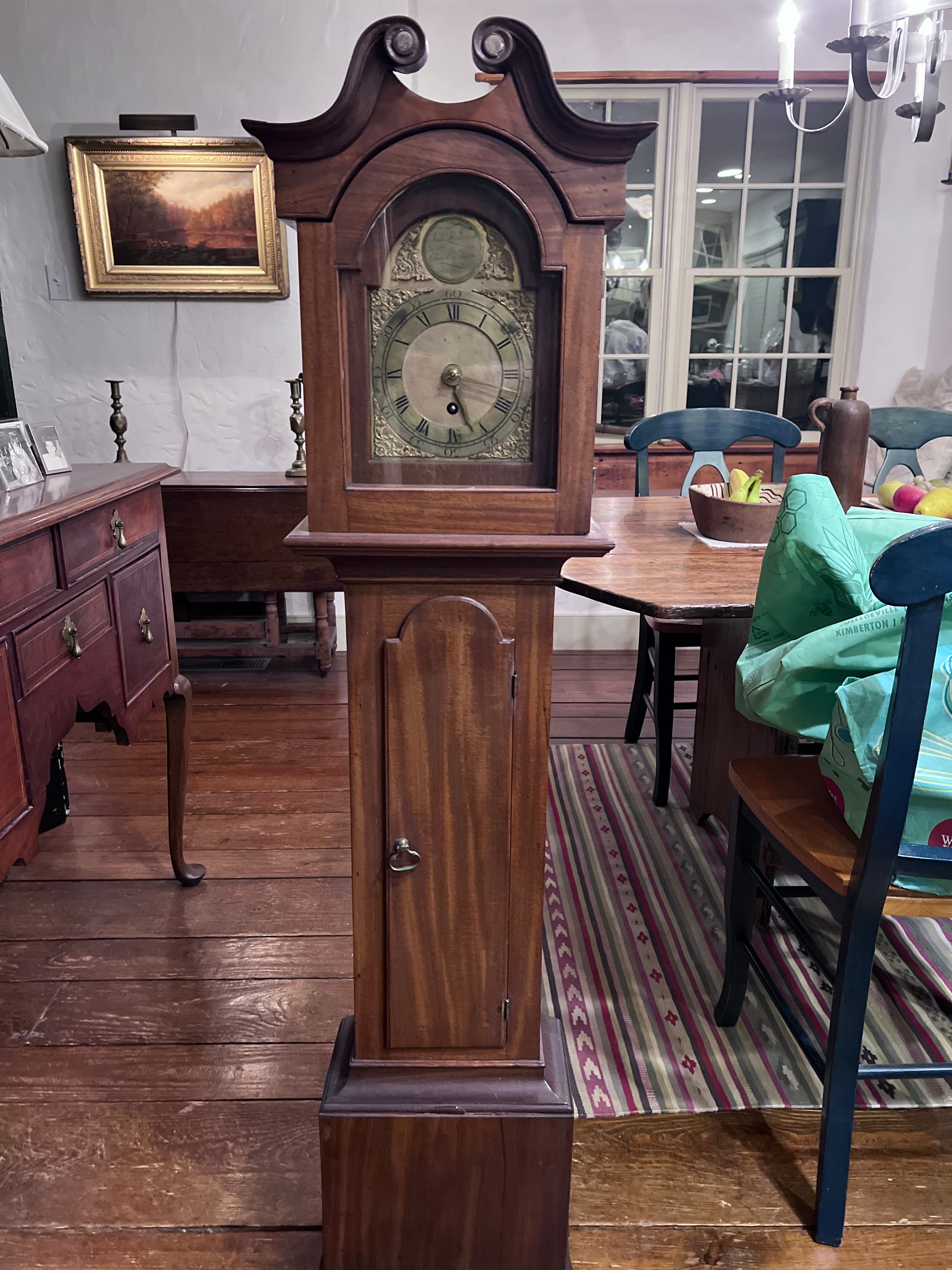
My father had a peculiar relationship with machines.
For a farmer, he was almost defiantly indifferent to them. Cars went unwashed forever. Tractor oil lived out two of its natural lifespans and then some. The tractor cab was a roving trash pit. Yet, in an odd reversal, the grease fittings on the machinery were always attended to as if crude lubrication alone was his negotiation with friction. But in the end, the biggest tractor objected, throwing connecting rods and wrist pins through the engine block… Through the U-beams that held the mammoth diesel… and ultimately, bits and pieces 50 yards on either side of the tractor. Lesson learned? Nope. He was good at farming though.
The Townsend clock received the same selective attention. He loved to see it and hear it, but not necessarily to care for it in the ways clockmakers or my brother might have recommended. He placed it near an exterior door… cold drafts, foot traffic, the whole atmospheric gauntlet a case clock is supposed to avoid. Brother Rick moved it a few feet to safer haven. It was right back in the line of fire 24 hours later.
Its continued heartbeat was either luck or something more spiritual, depending on how charitable one feels toward physics or my father.
The truth is, the clock largely took care of itself. Or even defended itself.
It’s an aspect of my father I never fully wrapped my head around; a man who treated machines with a farmer’s pragmatism yet kept this 300-year-old timekeeper close, as if proximity alone were the form of care he believed in.
And there was never a moment of uncertainty about where it belonged.
It was always going to Rick. Because Rick’s middle name is Townsend; a coincidence so perfect it stops being coincidence.
When my father died less than a year ago, the clock’s departure felt natural, almost ceremonial. It actually moved to its new home before he died. Dad knew… It was time for both of them. It simply stepped into the next room of its long life. As did Dad some week’s later
There was no envy, not from me, not from our sister. The fit was perfect And it was a relief to see it land in place that fully protects it.
A clock that old becomes a timeline in itself; gravity doing the counting, humans doing the caretaking. My father wound it; Rick winds it now. Someone else will wind it someday. The clock will keep time long after all of us have stepped out of its field of view. Speaking of beat count. Conservatively: 24 billion. I wonder when it was last lubricated. You-know-who didn’t do it.
That is the majesty of these machines:
they keep us, even as we think we are keeping them.
You are such a good writer, Chad.